
As 2025 draws to a close, we’re celebrating another remarkable year of growth, collaboration and innovation at touchINFECTIOUS DISEASES.
From thought-provoking expert interviews and peer-reviewed research to dynamic conference coverage and an expanding portfolio of medical education, this year has been defined by meaningful conversations and impactful learning. We’ve had the privilege of engaging with leading clinicians, researchers and partner societies across the globe – bringing together diverse voices to support the infectious diseases community with timely, accessible and authoritative content.
As we reflect on the past 12 months, we’re proud to highlight the moments, milestones and stories that shaped our year.
Here are just some of the standout highlights from 2025.
Conference and news coverage
We’ve been hard at work this year covering leading international conferences, including IAS, IDWeek, and EACS, highlighting ground-breaking policy, and the latest clinical updates. From news roundups to rapid-fire news blasts, we’ve made staying informed about the latest in infectious disease care quicker and easier than ever.
Top 5 most viewed interviews
1. Bacteriophage therapy: A powerful alternative to antibiotics in the fight against superbugs
Bacteriophage therapy uses viruses to infect and kill harmful bacteria, and is re-emerging as a powerful tool in the fight against multidrug-resistant infections. Once overshadowed by the discovery of antibiotics, this highly targeted treatment is now gaining global attention as antibiotic resistance continues to rise. In this Q&A, Ikechukwu Moses (Division of Infectious Diseases, EPM-UNIFESP, São Paulo, Brazil), explores how phage therapy works, its clinical applications, and what’s needed to bring it into mainstream infectious disease care.
2. New strategies for HIV prevention in a shifting funding landscape
Mitchell Warren discusses insights from the IAS 2025 session, “Re-imagining prevention: Planning for sustainable PrEP access in the new funding context”, highlighting the most pressing global HIV prevention priorities, the promise of long-acting pre-exposure prophylaxis (PrEP) technologies, and the need for urgent, equity-focused investment, especially amid uncertain funding landscapes.
3. NDM resistance trends and novel antibacterials: Key insights at IDWeek 2025
Dr Darius Hareza (Northwestern University, Chicago, USA) discusses major developments from IDWeek 2025, including the alarming rise in NDM-producing Enterobacterales, the approval of gepotidacin for gonorrhoea, and spirited debates around daptomycin versus vancomycin and new UTI treatment durations.
In this interview, Skye Opsteen, touchINFECTIOUS DISEASES Future Leader 2025, shares the moments that reinforced her dedication to her specialty, the invaluable lessons from mentors and advice for aspiring infectious disease researchers. She highlights the power of curiosity, mentorship and trusting one’s instincts in navigating the evolving landscape of infectious disease medicine.
Dr Xin Hui Chan’s research focuses on developing equitable therapies for high-threat infectious diseases. She combines clinical trials, evidence synthesis, and modelling to address neglected infections and improve global health outcomes.
Top viewed news articles
Launch of the ‘Future Leaders’ initiative
Introducing touchINFECTIOUS DISEASES Future Leaders 2025
As touchINFECTIOUS DISEASES continues its mission to deliver concise, expert-led content for busy clinicians, we’re proud to spotlight the future leaders of infectious disease specialists.
In our inaugural Future Leaders 2025 campaign, we celebrate early-career clinicians and researchers whose innovation, leadership, and curiosity are already shaping better outcomes in patient care, antimicrobial stewardship, and global health.
Following the success of this year’s programme, we’re excited to announce that nominations for the 2026 cohort will open early next year.
Journal highlights
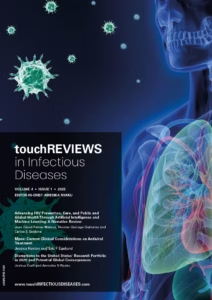 Volume 4, Issue 1 of touchREVIEWS in Infectious Diseases is now online here.
This edition features insightful editorials and review articles covering key topics such as COVID-19, HIV, and viral infections.
Top 5 most viewed articles
1. Mpox: Current Clinical Considerations on Antiviral Treatment
Mpox (formerly monkeypox), a double-stranded DNA virus of the Orthopoxvirus family, continues to pose a global health challenge. While early diagnosis and tailored treatment strategies to manage severe cases effectively are important, there are emerging antiviral agents in addition to the repurposing of existing drugs aimed at improving mpox management. Available antiviral treatments include tecovirimat, brincidofovir and cidofovir, as well as vaccinia immunoglobulin. Tecovirimat is highlighted as the first-line treatment, though concerns about drug resistance and efficacy may necessitate other therapies. Brincidofovir offers a safer alternative to cidofovir due to its reduced nephrotoxicity. This article reviews the clinical considerations for treating mpox, particularly in immunocompromised individuals.
Controlling the HIV epidemic requires more efficient, effective and tailored interventions. Artificial intelligence (AI) and machine learning (ML) have the potential to enhance the HIV response by improving prevention strategies, optimizing care and supporting public health efforts. In this article, we provide an overview of recent applications of AI, including ML and deep learning (DL), in the field. We also discuss important considerations related to implementation, ethics and future directions. This review aims to highlight the role of AI and ML approaches in controlling the HIV epidemic, with a focus on their applications in prevention, early diagnosis, HIV care and public health support. We conducted a narrative review using two databases: PubMed and Embase. The research strategy was developed using a combination of MeSH terms and keywords related to HIV, AI and ML methods. ML models have introduced advancements in HIV risk prediction, pre-exposure prophylaxis engagement and testing in low-resource settings. Additionally, ML approaches can predict clinical outcomes in HIV care, optimize treatment and identify factors that influence HIV transmission networks to improve the allocation of resources. While the findings are promising, future research should prioritize addressing bias, improving explainability and ensuring equity in AI and ML applications for HIV.
3. Plasma Biomarkers and Cognitive Decline in HIV: Insights from Two Cohorts in the USA
With advances in antiretroviral treatment, the population of older people living with HIV (PLWH) is increasing rapidly, leading to a rise in cognitive impairment related to both HIV and ageing. Plasma biomarkers have been extensively investigated as non-invasive tools to help detect neurodegeneration in PLWH. This review compares cross-sectional and longitudinal findings from two recent substudies conducted within cohorts in the USA, the AIDS Clinical Trials Group HIV Infection, Aging, and Immune Function Longitudinal Observational study and the Women’s Interagency HIV Study, both of which investigated the relationship between plasma biomarkers and cognitive performance in PLWH. This review focuses on the common biomarkers evaluated in both studies: neurofilament light chain (NfL) and glial fibrillary acidic protein (GFAP). Both studies demonstrated longitudinal associations between elevated NfL levels and poor cognitive performance, particularly in processing speed. In contrast, GFAP showed inconsistent associations, suggesting that its utility may be limited in clinical settings. Given that effect sizes across both studies ranged from small to modest, further validation in diverse ageing cohorts with domain-specific cognitive assessments is needed before routine clinical use.
4. Disruptions to the United States’ Research Portfolio in 2025 and Potential Global Consequences
In the first months of 2025, the new US administration has imposed sweeping research funding cuts and dismantled longstanding global collaborations. This editorial examines recent global health breakthroughs made possible by US–supported science, highlights areas where progress is now being systematically undermined and considers the immediate and long-term consequences of these policy shifts. We argue that the emerging anti-science agenda threatens human health today and jeopardizes the future of biomedical innovation and global solidarity.
5. Paxlovid: An Agent for the Treatment of Mild-to-moderate COVID-19
This article reviews the published data encompassing the development, pharmacology, efficacy and safety of nirmatrelvir/ritonavir, a second-generation protease inhibitor developed for the treatment of coronavirus disease 2019 (COVID-19).
Visionary Voices podcast
At Touch, we understand that healthcare professionals learn in different ways. Visionary Voices expands our content variety, ensuring we offer educational resources that cater to all learning preferences. Season 2 recently wrapped, with series 3 on the way…
Top 5 most viewed episodes
1. Polish up: What’s new in diagnosing and treating onychomycosis
Onychomycosis is one of the most common nail conditions seen in clinical practice, yet diagnosis is often uncertain and treatment failures are frustratingly common. In this episode, Dr Shari Lipner shares practical updates on smarter diagnostics, existing & emerging therapies, and what we need to know about how to manage this condition today and in the future.
2. On the spot: How point-of-care testing is tackling rising STI rates
In this episode, we explore how point-of-care testing is transforming the management of sexually transmitted infections (STIs). Joined by Dr Libby van Gerwen, we discuss the rising global STI rates and the role these innovative tests play in addressing the issue. We also explore the challenges current point-of-care tests face and how next-generation advancements could further transform the future of STI diagnosis and treatment.
3. What impact does sleep have on physicians and their patients?
We all know sleep is important, but what happens when physicians don’t get enough? In this episode of Visionary Voices, we welcome Associate Professor Grace Vincent from CQUniversity’s Appleton Institute. A leading expert on sleep and shift work, Grace explores how disrupted sleep affects physician health in both the short and long term, as well as its impact on safety and performance. We also discuss what this means for patient outcomes and share practical strategies to manage sleep loss.
4. Why are so many physicians burning out, and how can we break the cycle?
Physician burnout is at a critical point. In this episode, Nicky speaks with Dr Alfred Atanda about why so many physicians are burning out and what can be done to change the trend. From personal experience to system-wide solutions, Dr Atanda shares valuable insights on improving physician well-being and building a more effective healthcare culture.
5. Is pharma for me? Navigating the move from agency, clinic or academia
Whether you’re working in an agency, in a clinical role, or in academia, many healthcare professionals wonder what lies behind the doors of the pharmaceutical industry.
Highlighting society partnerships
Our collaborations with leading professional societies continue to be a cornerstone of our work.
This year, we strengthened these partnerships to amplify expert voices, support awareness days and bring forward the latest developments shaping the care of infectious diseases. Below are some of the key moments from our society collaborations in 2025.
STI & HIV 2025 World Congress: Global progress, key trials and what’s next
The STI & HIV World Congress is the leading global forum on sexually transmitted infections (STIs), HIV, and sexual health. Jointly organized by the International Society for Sexually Transmitted Diseases Research (ISSTDR) and the International Union Against Sexually Transmitted Infections (IUSTI), it convenes every two years to bridge cutting-edge science with policy, implementation, and community practice.
ProMED: Strengthening global outbreak vigilance through human-curated intelligence
In this Q&A, Jarod Hanson, Chief Content Office of ProMED, in affiliation with ISID, discuss how the ProMED platform continues to empower clinicians and epidemiologists worldwide, its evolving integration of AI, and how new partnerships aim to extend its reach into low-resource settings to strengthen the global early warning system.
#ShowYourStripes for Rare Disease Day!
Medics for Rare Disease, a UK registered charity, is asking healthcare professionals and healthcare students from UK and beyond, to join forces, to help drive rare disease awareness in the run up to Rare Disease Day, 28th February. Rare Disease Day is an important day to those impacted by rare conditions, globally. It was originally established in 2008, by Eurodis to ‘increase equity for people living with a rare disease, improving their lives with equitable access to diagnosis, treatment, care and social opportunity’. It is celebrated on the last day of February, because in leap years it is on 29th of February, the rarest day!
Medics For Rare Disease – New Year, New Strategy
Medics4RareDiseases is evolving. We are excited to announce a refresh of our strategy, a relaunch of our branding and even a new name! The charity has grown beyond our highest expectations over the last five years. With this in mind the team spent much of the last year working alongside our partners, Emotive, to ensure we are harnessing that growth to its highest potential whilst heading in the best direction for the charity. With this came a complete branding refresh. We updated the charity’s mission and goals to set the scene for a new phase of growth.
As we wrap up an exciting year of growth, new content formats and meaningful collaborations, we’re immensely proud of the progress made across touchINFECTIOUS DISEASES. With even more innovations, insights and educational initiatives on the horizon, we look forward to bringing you an even stronger year of content in 2026.
Cite: touchWRAPPED 2025: Your top reads, watches and listens in infectious diseases. touchINFECTIOUS DISEASES. 15 December 2025.
Disclosures: This article was created by the touchINFECTIOUS DISEASES team utilizing AI as an editorial tool (ChatGPT (GPT-4o) [Large language model]. https://chat.openai.com/chat.) The content was developed and edited by human editors. No funding was received in the publication of this article.
Related content:

Register now to receive the touchINFECTIOUS DISEASES newsletter!
Don’t miss out on hearing about our latest peer reviewed articles, expert opinions, conference news, podcasts and more.