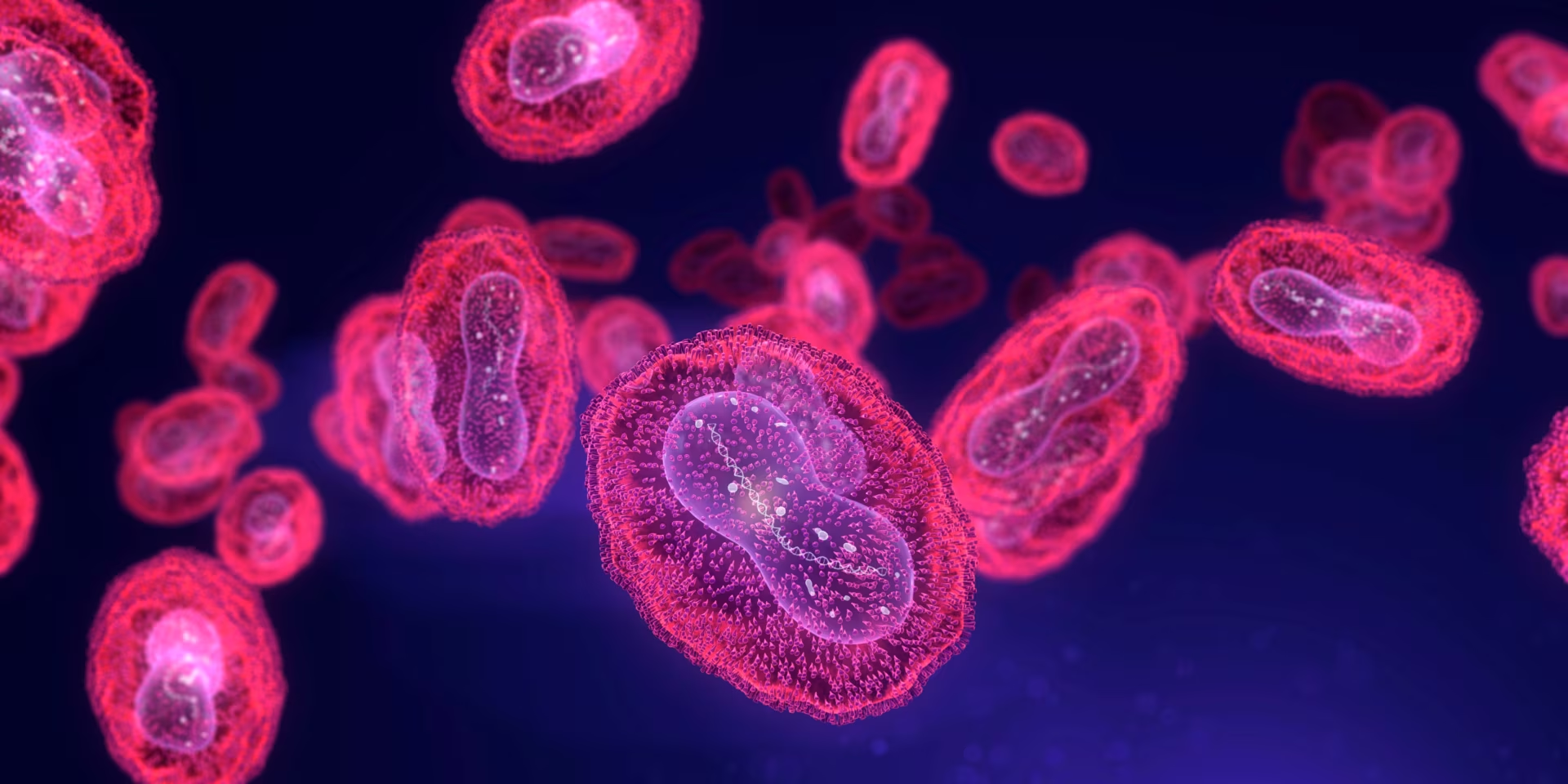

Dr Christoph Boesecke (University Hospital Bonn, Germany) presented a study using the Mpox Severity Score system, at the 19th European AIDS Conference (EACS 2025). The Mpox Severity Score system is a tool designed to standardize clinical assessment and improve understanding of disease progression. In this interview, he discusses the system’s clinical relevance, evolving mpox trends since the 2022-2023 outbreaks, and key updates from EACS 2025.
Session: Boesecke C. Mpox – from prevention to clinics. Session #RO1. 19th European AIDS Conference (EACS 2025). 16-18 October 2025.
The Mpox Severity Score is a standardized clinical tool developed to objectively assess disease severity and guide management decisions. The score incorporates multiple clinical parameters mainly focusing on skin lesions (number, location, mucosal involvement, bacterial superinfection) but also need for analgesia and hospitalisation which helps clinicians identifying patients at risk of severe disease. The system aims to unify reporting and improve early recognition and triage across different healthcare settings.
In our cohort, most patients had a good immune system, many were PrEP users, and we clearly saw that disease severity was lower among those who were partially or fully vaccinated. This is one of the first cohorts to show that even partial vaccination reduces both the severity and the number of lesions seen in mpox infection. That’s really important for clinicians, because it highlights that vaccination must remain a top priority to curtail the mpox epidemic.
The data we presented relates to clade 2B, not clade 1, which remains endemic in Africa (clade 2B is the strain of the mpox virus responsible for the major global outbreak that began in 2022, whereas Clade 1 is a different, more severe strain historically confined to Central Africa). As with any infectious disease, vaccination is key to ending the outbreak. Encouragingly, even partial vaccination provides protection. In resource-limited settings, where vaccine supply is scarce, it may be possible to prioritise first doses, giving one dose to two individuals, and complete second doses later. On a global scale, this could be the most pragmatic way forward.
We learned that clade 2B infection tends to be milder in people who are vaccinated and immunocompetent. Those admitted to hospital generally require pain management rather than treatment for severe disease. Hospitalisations often relate to rectal mucosal pain requiring opioids.
The patients who become most unwell are typically those with uncontrolled HIV or new HIV diagnoses at the time of mpox infection. Because mpox often presents alongside other sexually transmitted infections, these individuals have weakened immune systems and may not yet be on treatment. In these cases, the virus can progress aggressively.
The scoring system helps clinicians to assess and track these variations in severity, supporting better triage and management decisions, especially where diagnostic resources are limited.
In clinical management, it’s important to remember that skin manifestations can be subtle. Some patients present with only one to three small lesions, which can sometimes be hidden, and can easily be missed if clinicians don’t perform a full skin examination. In contrast, systemic symptoms such as lymphadenopathy, fever and chills are far more common.
Any patient being investigated for a potential sexually transmitted infection should be assessed for mpox as part of the diagnostic workup. We observed that vaccinated patients experience fewer systemic symptoms such as fever and lymphadenopathy. Combining these symptoms with the existing severity score may further improve the performance of the tool.
We need data from international cohorts, it’s never useful if findings are limited to one country, as disease patterns vary across different populations. More research is particularly needed on clade 1 mpox in children and adolescents. These groups appear to experience more severe illness, likely because of differences in immune system maturity and viral characteristics. Understanding these differences is crucial to developing effective prevention and treatment strategies.
The conference had a major focus on HIV prevention. France and the EACS conference chairs have been leaders in this area, particularly around PrEP. We saw a lot of exciting data on PrEP, including emerging subcutaneous and intramuscular formulations. Access and reimbursement remain a challenge in parts of Europe, but some of these newer drugs are already licensed, and we’ll soon see how they integrate into clinical practice.
My personal highlight was the release of the updated EACS living guidelines, always a popular session. These are now continuously updated in real time as new data emerge. Key updates included new sections on HIV-2 infection, injectable PrEP, and HIV management in pregnancy. The guidelines are accessible through the EACS app, which I’d highly recommend for clinicians.
And, of course, I’m thrilled that the next EACS conference will be held in Prague from 6–9 October 2027, where I’ll serve as co-chair. We’ll be shaping a new focus and theme, but as always, the guidelines will remain one of the key features and highlights.
Related content
- Co-chairs highlights: HIV treatment and prevention research highlights EACS 2025
- Expert voices on the future of HIV prevention
- Prof Barbara Van Der Pol: A voice for change in sexual health
This content has been developed independently by Touch Medical Media for touchINFECTIOUS DISEASES. Views expressed are the speaker’s own and do not necessarily reflect the views of Touch Medical Media.
Session: Boesecke C. Mpox – from prevention to clinics. Session #RO1. 19th European AIDS Conference (EACS 2025). 16-18 October 2025.
Editor: Katey Gabrysch, Editorial Director.
Disclosures: This short article was prepared by touchINFECTIOUS DISEASES in collaboration with Christoph Boesecke. The content was developed and edited by human editors. No fees or funding were associated with its publication. touchINFECTIOUS DISEASES utilize AI as an editorial tool (ChatGPT (GPT-4o) [Large language model]. https://chat.openai.com/chat).
Christoph Boesecke has received honoraria for lectures and/or consultancies from AbbVie, Astra Zeneca, Bavarian Nordic, Gilead, Janssen, MSD, Pfizer, ViiV as well as institutional funding from DFG, Dt. Leberstiftung, DZIF, Hector Stiftung, NEAT ID.
Cite: Christoph Boesecke. What clinicians need to know about mpox in 2025: Mpox Severity Score system, vaccination and HIV links. touchINFECTIOUS DISEASES. 20 October 2025.
Register now to receive the touchINFECTIOUS DISEASES newsletter!
Don’t miss out on hearing about our latest peer reviewed articles, expert opinions, conference news, podcasts and more.