Phase III PRIOH data suggest pritelivir could offer a new oral treatment option for immunocompromised patients with refractory herpes simplex virus, delivering improved lesion healing over investigator’s choice therapy.
Refractory herpes simplex virus (HSV) infection remains a significant challenge in immunocompromised patients, particularly when resistance to standard antiviral therapies develops and treatment options are limited by toxicity.
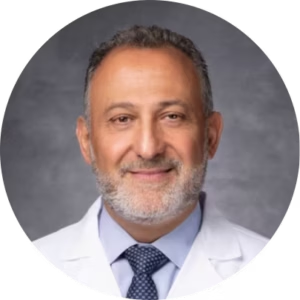
At ESCMID 2026, Prof. Roy Chemaly (The University of Texas MD Anderson Cancer Center, Houston, TX) joins us to discuss findings from the Phase III PRIOH-1 trial, in which pritelivir demonstrated superior lesion healing compared with investigator’s choice treatment. In this interview, Dr Chemaly discusses the unmet need in this vulnerable population, the key efficacy and safety findings, and how pritelivir could help reshape future management of refractory or resistant HSV infection.
Presented at ESCMID 2026: Abstract # L0016. Positive treatment response of pritelivir achieved in refractory HSV infections in immunocompromised patients: PRIOH-1 phase III trial.
Q. What unmet clinical need does refractory HSV infection present in immunocompromised patients, and why have treatment options historically been limited?
HSV in immunocompromised patients, mainly stem cell transplant recipients, solid organ transplant recipients, and people living with HIV, is not uncommon, especially in patients who are not taking preventive therapy such as prophylaxis..
Most of us carry latent HSV, meaning we have been exposed to it in our lives, and it remains in the body. It does not go away. As soon as the immune system is weakened, it can reactivate.
That is why we place many immunocompromised patients on prophylaxis, but some still experience breakthrough infection while receiving preventive treatment. In these patients, because they are heavily immunosuppressed, HSV can become severe. It may become refractory, meaning it does not respond to treatment, or resistant, meaning it has developed mutations that prevent standard antivirals from working.
When that happens, we move away from drugs such as acyclovir or valacyclovir to alternative therapies. The main alternative is foscarnet, which must be given intravenously. However, it can cause serious toxicities, including kidney dysfunction, kidney failure, electrolyte imbalances and other adverse effects. Another option is intravenous cidofovir, which is can also cause toxicities and often less effective than foscarnet.
So the available options for refractory HSV infection have historically been limited by toxicity, intravenous administration and the burden of hospitalization. That is why this remains a major unmet need for a safer, better tolerated and ideally oral treatment option.
Q. Could you describe the design and the key findings from the Phase III PRIOH-1 trial, particularly the lesion healing outcomes seen with pritelivir versus investigator’s choice treatment?
This has been a programme led by AiCuris to address the unmet need in refractory and resistant HSV infection in immunocompromised patients, including transplant recipients, patients with hematologic malignancies, people living with HIV and patients with autoimmune diseases.
This Phase III trial was a randomized, open-label study comparing oral pritelivir with investigator’s choice treatment. A total of 101 patients were enrolled, 51 patients were enrolled in the pritelivir arm, while the investigator’s choice arm mainly used intravenous foscarnet, with some patients receiving intravenous cidofovir or topical imiquimod. Patients were randomized 1:1.
- The primary endpoint was complete lesion healing through Day 28. Lesions were clinically significant, with a mean baseline lesion length of 34.1 mm.
- At Day 28, 62.7% of patients receiving pritelivir achieved complete lesion healing compared with 34.0% receiving investigator’s choice treatment, with an adjusted treatment difference of 28.4% (95% CI 9.6–47.3; p=0.0047).
- At Day 42, lesion healing rates increased further. 82.4% of patients receiving pritelivir achieved complete healing compared with 42.0% receiving investigator’s choice treatment, with an adjusted treatment difference of 40.2% (95% CI 22.7–57.7; p<0.0001).
So even when longer treatment was needed, pritelivir continued to show clearly superior outcomes at both timepoints.
Q. What did the trial show regarding safety and tolerability?
When we compared the safety profile of pritelivir with investigator’s choice treatment, we saw fewer treatment-emergent adverse events with pritelivir.
- In the safety population, 80.4% of patients receiving pritelivir experienced any treatment-emergent adverse event (TEAE), compared with 90.0% in the investigator’s choice arm. Drug-related TEAEs occurred in 21.6% versus 54.0%, respectively.
- Treatment discontinuation due to drug-related TEAEs occurred in 2.0% of patients receiving pritelivir compared with 20.0% receiving investigator’s choice treatment.
- Renal/urinary disorders were reported in 5.9% of pritelivir-treated patients versus 26.0% with investigator’s choice. Electrolyte abnormalities occurred in 2.0% versus 16.0%.
Overall, pritelivir appeared better tolerated, with fewer discontinuations and fewer toxicities, and with no major new safety signals identified.
Q. Pritelivir is an oral helicase-primase inhibitor. How significant is the availability of an effective oral option compared with current salvage therapies such as intravenous foscarnet?
It is highly significant. First, it is oral, so patients do not need to be admitted for intravenous treatment. That removes the burden of hospitalization and IV administration.
Second, it has good bioavailability, more than 75%, and a half-life of approximately 60 hours, allowing once-daily dosing.
Most importantly, it does not appear to have the serious toxicity profile we associate with foscarnet. Foscarnet can be a very toxic IV drug that often causes kidney dysfunction and electrolyte abnormalities. With pritelivir, we did not see those same concerns. That makes it a very appealing option for this major unmet need.
Q. How clinically meaningful are these virological outcomes for patient management?
These outcomes are very clinically meaningful. Once pritelivir becomes available, hopefully after regulatory approval, we may be able to treat suspected refractory or resistant HSV infection quickly in the outpatient setting.
That means we would not need to admit patients for IV therapy or delay treatment while arranging hospitalization. We also may not need to wait for genotypic resistance testing before acting.
Being able to start an oral, well-tolerated treatment early could make a major difference for patients.
Q. Looking ahead, how do you see pritelivir potentially changing treatment pathways for immunocompromised patients with refractory or resistant HSV infection?
I think it could change treatment pathways significantly. Hopefully, once it becomes available, we will have an additional safe and effective oral option that can be used quickly in the outpatient setting as soon as refractory or resistant infection is suspected.
We would no longer need to rely immediately on toxic IV therapies or wait for hospital admission. We could intervene earlier and hopefully achieve the same kind of outcomes we saw in the trial.
By Day 28, many patients had complete healing, and by Day 42 more than 80% had achieved clinical cure. That compares with around 40% in the investigator’s choice arm.
These infections can be extremely painful and debilitating. Lesions may be large, necrotic and especially distressing in the genital area. If we can provide faster healing, reduce pain and lower treatment burden, that would be a major advance for a very sick patient population.
Q. What do you think will be the most important therapeutic or treatment updates presented at ESCMID 2026?
I think there will be a lot of important vaccine data, because prevention is clearly a major trend right now, particularly around respiratory viruses and pneumococcal disease.
We will also hear a great deal about multidrug-resistant organisms, including new data on the evolution of resistance and how to manage bacterial infections with rising resistance rates.
There are also several newer antibiotics that have been approved recently, are already in use, or are still in development. I think we will hear a lot about how best to position these drugs in clinical practice, especially in populations with high resistance burdens.
Already registered? Login below.

Related content
Respiratory virus transmission and new approaches to measuring individual infectiousness
New evidence for high-dose influenza vaccines in older adults: DANFLU-2 trial
Pritelivir shows superior lesion healing in refractory herpes simplex virus: Phase III PRIOH trial
More content in viral infections
Cite: Roy Chemaly. Pritelivir shows superior lesion healing in refractory herpes simplex virus: Phase III PRIOH trial. touchINFECTIOUS DISEASES. 17 March 2026.
Abstract: Roy Chemaly. Positive treatment response of pritelivir achieved in refractory HSV infections in immunocompromised patients, including haematopoietic stem cell and solid organ transplant recipients and oncology patients: PRIOH-1 phase III trial. Abstract #L0016. Presented at ESCMID 2026, Munich, Germany 17 – 21 April 2026
Editor: Katey Gabrysch, Editorial Director.
Disclosures: Prof. Roy Chemaly is a consultant for AiCuris; has recieved grant/research support from AiCuris; and is on the advisory board for AiCuris.
The content was developed and edited by human editors. No fees or funding were associated with its publication. touchINFECTIOUS DISEASES utilize AI as an editorial tool (ChatGPT (GPT-4o) [Large language model]. https://chat.openai.com/chat).
This content has been developed independently by Touch Medical Media for touchINFECTIOUS DISEASES in collaboration with Prof. Roy Chemaly. Views expressed are the speaker’s own and do not necessarily reflect the views of Touch Medical Media.
SIGN UP to touchINFECTIOUS DISEASES!
Join our global community today for access to thousands of peer-reviewed articles, expert insights, and learn-on-the-go education across 150+ specialties, plus concise email updates and newsletters so you never miss out.