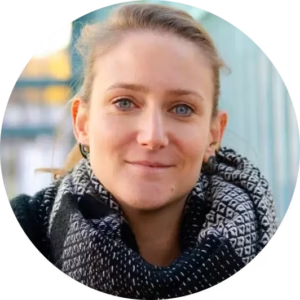
At ESCMID Global 2026, recognized as a touchINFECTIOUS DISEASES Future Leader 2026 and recipient of a Young Investigator Award, Dr Sarah Delliere (Université Paris Cité, Paris, France) discussed the growing momentum behind medical mycology and the need to rethink how invasive fungal infections are diagnosed and treated.
In this Q&A, Dr Delliere, explores why host immunity may unlock more precise diagnostics, how collaboration will shape the future of mycology, and why mentorship and visibility remain essential in the field.
Presented at ESCMID 2026: Beyond the Mold: Shifting Diagnosis and Therapy Through Host Immunity. Young Investigator Award Lecture
Q. Could you tell us a little about yourself, your background and your current role?
I’m an MD by training. I completed a residency in clinical microbiology and then specialized further in medical mycology. At the moment, I am an Associate Professor at Université Paris Cité in Paris. I split my time between research at Institut Pasteur and hospital practice, where I work as a clinical microbiologist. In parallel I obtained a PhD on fungal immunology at Institut Pasteur.
Q. Congratulations on being recognised as a touchINFECTIOUS DISEASES Future Leader. What does this recognition mean to you at this stage of your career?
Thank you. It is, of course, a real honor and an important personal recognition. I also think visibility matters. For women in particular, we still often need to go a little further and do a little more to receive the same recognition, so it is meaningful on that level as well.
It is also important for the field itself. Mycology is still frequently overlooked within infectious diseases and microbiology more broadly. If this recognition helps shine a light on an under-recognized specialty and encourages more people to become interested in fungal diseases, then that is something I value greatly.
Q. Your work bridges clinical microbiology, medical mycology and translational research. What key experiences have shaped your journey so far?
I think the most important influence has actually not been medical at all for me, it has been travel. I left home at 17 to go and play tennis at a university in the United States for a year. Later, I completed a Master of Science in Canada. I also worked in an infectious diseases ward in Colombia and in an emergency ward in Cambodia.
Each of those experiences pushed me outside my comfort zone. They forced me to adapt to new languages, new cultures, new healthcare systems, and new ways of working.
Looking back, adaptability has probably been the most valuable skill in helping me move between clinical microbiology, translational research, and mycology. Research is constantly about adapting, to new people, new ideas, new environments, and new challenges. At the time, I did many of those things simply because they interested me. But in hindsight, they were probably some of the most formative experiences of my career.
Q. As an emerging leader in fungal diseases, what opportunities or challenges do you think will define the future of infectious diseases research over the next decade?
For fungal diseases specifically, one of the biggest challenges is that these infections are often relatively rare, but they are also highly lethal. That means if we want to generate strong evidence, collaboration is essential. No single center, country, or laboratory can answer the most important questions alone.
The difficulty is that research can be very competitive. So the ability to build bridges beyond borders, beyond institutions, and beyond individual labs will probably be one of the most important factors in moving the field forward over the next decade.
Q. Based on your presentation at ESCMID 2026, how is host immunity helping to shift the diagnosis and treatment of invasive fungal infections, and what could this mean for future clinical practice?
Until now, we have been almost entirely focused on the pathogen itself. But resistance is rising, mortality rates have not improved enough over recent decades, and in many ways it feels as though we have reached a ceiling in fungal infections.
What has been comparatively overlooked is the host side. There is essentially no invasive fungal disease in someone with a normal immune system. So the real question becomes: what is happening within host immunity that allows these infections to occur?
If we better understand host-pathogen interactions, we may be able to develop entirely new diagnostic tools. Instead of only searching for fungal fragments, which are often not sensitive enough, we could identify immune signatures showing that a patient is in the precise state where invasive fungal disease is likely.
That could also help us distinguish infection from colonization, which is particularly difficult when molds are grown from respiratory samples, because molds are everywhere in the environment.
The same principle applies to treatment. Rather than only targeting fungi with antifungal drugs, we may be able to restore or boost the immune pathways that are missing or impaired.
That is where I think the future lies: personalized medicine, where treatment is tailored to the specific immune deficit and we help restore immune homeostasis so the patient can fight the infection more effectively.
Q. Who have been the key mentors or influences in your career so far?
That is a difficult question, because some of the most important mentors were not necessarily the people I worked with most closely. Often, they were people I may have spent only a short time with during an internship or residency, but who remained available afterward, people I could contact for advice on research, career decisions, or difficult situations.
One particularly important mentor has been Françoise Botterel. She is a former president of the French Medical Mycology Society, and she became something of a mother figure in the field for me, even though we initially only worked together for six months during residency.
Another is Riina Richardson (The University of Manchester, UK), who has always been generous with support and advice.
Female role models are especially important, because there are still too few women in senior leadership positions. Many of those who reached those roles had to navigate much harder conditions than we do now, and their experience is incredibly valuable.
Q. What were your personal highlights, and what do you think will be the most important updates presented at ESCMID 2026?
One of the clearest themes already is the rise of artificial intelligence. ESCMID has covered that extremely well this year. AI is now touching every area, education, research, diagnostics, and clinical care, and I think it is important that we understand it while it is still emerging, before it moves too quickly.
Compared with last year, when it still felt like the beginning, this year there are many more sessions dedicated to AI. That matters because it helps people understand how to use it, how to use it responsibly, and how to integrate it meaningfully into practice.
Related content
Respiratory virus transmission and new approaches to measuring individual infectiousness
New evidence for high-dose influenza vaccines in older adults: DANFLU-2 trial
Pritelivir shows superior lesion healing in refractory herpes simplex virus: Phase III PRIOH trial
More content in fungal infections
Cite: Sarah Delliere. Advancing fungal disease diagnosis through host immunity. touchINFECTIOUS DISEASES. 17 March 2026.
Abstract: Sarah Delliere. Beyond the Mold: Shifting Diagnosis and Therapy Through Host Immunity. Presented at ESCMID 2026, Munich, Germany 17 – 21 April 2026
Editor: Katey Gabrysch, Editorial Director.
Disclosures: Sarah Delliere has nothing to disclose in relation to this interview.
The content was developed and edited by human editors. No fees or funding were associated with its publication. touchINFECTIOUS DISEASES utilize AI as an editorial tool (ChatGPT (GPT-4o) [Large language model]. https://chat.openai.com/chat).
This content has been developed independently by Touch Medical Media for touchINFECTIOUS DISEASES in collaboration with Sarah Delliere. Views expressed are the speaker’s own and do not necessarily reflect the views of Touch Medical Media.
SIGN UP to touchINFECTIOUS DISEASES!
Join our global community today for access to thousands of peer-reviewed articles, expert insights, and learn-on-the-go education across 150+ specialties, plus concise email updates and newsletters so you never miss out.