Conflict, war and displacement are increasingly recognised as major drivers of antimicrobial resistance (AMR), creating conditions where infections spread rapidly and access to healthcare, diagnostics and effective treatment is severely disrupted.

At ESCMID 2026, Prof. Souha Kanj (American University of Beirut Medical Center, Lebanon) discussed the urgent challenges of managing AMR in conflict zones and vulnerable patient populations. In this interview, she explores the pathogens emerging most frequently during war, the patients at greatest risk and the practical strategies needed to strengthen stewardship, infection control and global preparedness in one of healthcare’s most pressing areas.
Presented at ESCMID 2026: AMR worldwide threats, a looming living landscape.
Q. Could you tell us a little about your background and current research? My name is Souha Kanj. I am Professor of Medicine and Infectious Diseases at the American University of Beirut Medical Center. I am also Chair of the Infection Control Program and Co-Chair of the Antimicrobial Research Program at AUBMC. In addition, I am a Consulting Professor at Duke University Medical Center, an Honorary Doctor at Radboud University and currently President of the International Society of Antimicrobial Chemotherapy.
Q. How is war contributing to the rise and spread of antimicrobial resistance, and what are the most concerning consequences for healthcare systems?
Wars and conflicts create a perfect storm for the spread of antimicrobial resistance. Several factors contribute to this, including destruction of healthcare facilities, breakdown of infection control practices and limited access to diagnostics and effective medicines. This inevitably leads to increased morbidity and mortality.
Conflicts also disrupt immunization programmes, resulting in greater spread of infectious diseases. Without access to diagnostics, antibiotics are often used empirically for any fever, without knowing whether the cause is bacterial or viral.
Displaced populations are frequently living in overcrowded and very poor conditions, often without clean water or sanitation. In some settings, such as Gaza, wastewater can mix with drinking water supplies, which has serious implications for infectious diseases and AMR. Malnutrition is another major risk factor, weakening the immune system and increasing susceptibility to infection.
As a result, multidrug-resistant organisms are not confined to refugee camps or displaced populations. They spread into the wider community and environment.
Q. Which resistant pathogens or infection patterns are most commonly emerging in conflict settings?
Broadly, we can divide these into bacterial and fungal pathogens. Among bacterial infections, multidrug-resistant Gram-negative organisms are the most concerning.
During the Iraq and Afghanistan conflicts, Acinetobacter baumannii became particularly prominent and was even referred to as “Iraqibacter”. We now know this pathogen emerges in many conflict zones and is difficult to treat because therapeutic options are limited.
More recently, in the Ukraine conflict for example, we have also seen increasing rates of carbapenem-resistant Enterobacterales, including metallo-beta-lactamase-producing organisms. These infections are associated with high mortality and are especially difficult to manage where access to newer agents is limited.
Among Gram-positive pathogens, methicillin-resistant Staphylococcus aureus remains important, although Gram-negative organisms predominate.
We are also seeing fungal infections, including mucormycosis and resistant aspergillosis, particularly in wounded patients.
Q. Which patients are vulnerable to AMR, and why?
There are two major groups. First, injured patients are highly vulnerable because they may acquire resistant pathogens at the site of injury or during transfer to referral centres.
Second, people with weakened immunity are at greatest risk of poor outcomes. Again, Gaza is an example where severe malnutrition is weakening immune systems to the point that patients struggle to survive once they develop multidrug-resistant infections.
We also see secondary spread within hospitals. If infection prevention measures are not rigorously maintained, these resistant organisms can spread to cancer patients, transplant recipients and other vulnerable groups who were not directly affected by conflict injuries.
Healthcare workers in war settings are often under enormous pressure, focused on urgent trauma care, so infection control understandably becomes much harder to maintain.
Q. What clinical strategies and policy actions are most urgently needed to tackle AMR in both conflict zones and high-risk hospital populations?
For many years we have discussed global AMR action plans, but real impact will come from implementing stewardship and infection control directly where conflict-related injuries occur.
This can start with practical measures such as protocols for wound debridement, cleaning and disinfection before defaulting to antibiotics. We need consistent treatment pathways so that clinicians in field hospitals and referral centres are working to the same standards.
Access to rapid diagnostics and effective antimicrobials is also essential. Without microbiological guidance, clinicians are forced to use unnecessarily broad-spectrum treatment. Simple locally implemented measures can have a major effect on reducing the emergence and spread of AMR.
Q. What do you think will be the next steps?
We need better education for first responders, including NGOs and healthcare agencies working in conflict settings, so they understand stewardship principles. We also need funding directed to the right places. Too often resources are not channelled where they are needed most.
Partnership programmes that connect expertise and resources with regions in need are extremely valuable. We need to think creatively and collaboratively if we want to make progress.
Importantly, we also need to keep highlighting the economic impact of AMR, not only on individual countries, but on regions and globally. Policymakers often respond most strongly when they understand the financial consequences.
Q. What have been the most important updates presented at ESCMID 2026?
What I usually look for at ESCMID are innovations in the field, because these continue to drive new ideas and new solutions. I also enjoy visiting the poster sessions to see the ideas being presented by junior doctors and early-career researchers, because they represent the future of infectious diseases.
Register now for FREE access Already registered? Login below.
My name is Souha Kanj. I am Professor of Medicine and Infectious Diseases at the American University of Beirut Medical Center. I am also Chair of the Infection Control Program and Co-Chair of the Antimicrobial Research Program at AUBMC. In addition, I am a Consulting Professor at Duke University Medical Center, an Honorary Doctor at Radboud University and currently President of the International Society of Antimicrobial Chemotherapy.
Q. How is war contributing to the rise and spread of antimicrobial resistance, and what are the most concerning consequences for healthcare systems?
Wars and conflicts create a perfect storm for the spread of antimicrobial resistance. Several factors contribute to this, including destruction of healthcare facilities, breakdown of infection control practices and limited access to diagnostics and effective medicines. This inevitably leads to increased morbidity and mortality.
Conflicts also disrupt immunization programmes, resulting in greater spread of infectious diseases. Without access to diagnostics, antibiotics are often used empirically for any fever, without knowing whether the cause is bacterial or viral.
Displaced populations are frequently living in overcrowded and very poor conditions, often without clean water or sanitation. In some settings, such as Gaza, wastewater can mix with drinking water supplies, which has serious implications for infectious diseases and AMR. Malnutrition is another major risk factor, weakening the immune system and increasing susceptibility to infection.
As a result, multidrug-resistant organisms are not confined to refugee camps or displaced populations. They spread into the wider community and environment.
Q. Which resistant pathogens or infection patterns are most commonly emerging in conflict settings?
Broadly, we can divide these into bacterial and fungal pathogens. Among bacterial infections, multidrug-resistant Gram-negative organisms are the most concerning.
During the Iraq and Afghanistan conflicts, Acinetobacter baumannii became particularly prominent and was even referred to as “Iraqibacter”. We now know this pathogen emerges in many conflict zones and is difficult to treat because therapeutic options are limited.
More recently, in the Ukraine conflict for example, we have also seen increasing rates of carbapenem-resistant Enterobacterales, including metallo-beta-lactamase-producing organisms. These infections are associated with high mortality and are especially difficult to manage where access to newer agents is limited.
Among Gram-positive pathogens, methicillin-resistant Staphylococcus aureus remains important, although Gram-negative organisms predominate.
We are also seeing fungal infections, including mucormycosis and resistant aspergillosis, particularly in wounded patients.
Q. Which patients are vulnerable to AMR, and why?
There are two major groups. First, injured patients are highly vulnerable because they may acquire resistant pathogens at the site of injury or during transfer to referral centres.
Second, people with weakened immunity are at greatest risk of poor outcomes. Again, Gaza is an example where severe malnutrition is weakening immune systems to the point that patients struggle to survive once they develop multidrug-resistant infections.
We also see secondary spread within hospitals. If infection prevention measures are not rigorously maintained, these resistant organisms can spread to cancer patients, transplant recipients and other vulnerable groups who were not directly affected by conflict injuries.
Healthcare workers in war settings are often under enormous pressure, focused on urgent trauma care, so infection control understandably becomes much harder to maintain.
Q. What clinical strategies and policy actions are most urgently needed to tackle AMR in both conflict zones and high-risk hospital populations?
For many years we have discussed global AMR action plans, but real impact will come from implementing stewardship and infection control directly where conflict-related injuries occur.
This can start with practical measures such as protocols for wound debridement, cleaning and disinfection before defaulting to antibiotics. We need consistent treatment pathways so that clinicians in field hospitals and referral centres are working to the same standards.
Access to rapid diagnostics and effective antimicrobials is also essential. Without microbiological guidance, clinicians are forced to use unnecessarily broad-spectrum treatment. Simple locally implemented measures can have a major effect on reducing the emergence and spread of AMR.
Q. What do you think will be the next steps?
We need better education for first responders, including NGOs and healthcare agencies working in conflict settings, so they understand stewardship principles. We also need funding directed to the right places. Too often resources are not channelled where they are needed most.
Partnership programmes that connect expertise and resources with regions in need are extremely valuable. We need to think creatively and collaboratively if we want to make progress.
Importantly, we also need to keep highlighting the economic impact of AMR, not only on individual countries, but on regions and globally. Policymakers often respond most strongly when they understand the financial consequences.
Q. What have been the most important updates presented at ESCMID 2026?
What I usually look for at ESCMID are innovations in the field, because these continue to drive new ideas and new solutions. I also enjoy visiting the poster sessions to see the ideas being presented by junior doctors and early-career researchers, because they represent the future of infectious diseases.
Already registered? Login below.
Related content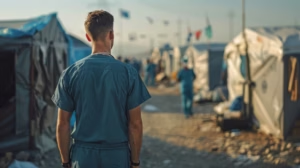
Respiratory virus transmission and new approaches to measuring individual infectiousness
New evidence for high-dose influenza vaccines in older adults: DANFLU-2 trial
Pritelivir shows superior lesion healing in refractory herpes simplex virus: Phase III PRIOH trial
More content in AMR
Cite: AMR during conflict: Why war fuels antimicrobial resistance. touchINFECTIOUS DISEASES. 17 March 2026.
Session: Souha Kanj. AMR worldwide threats, a looming living landscape. Presented at ESCMID 2026, Munich, Germany 17 – 21 April 2026.
Editor: Katey Gabrysch, Editorial Director.
Disclosures:
The content was developed and edited by human editors. No fees or funding were associated with its publication. touchINFECTIOUS DISEASES utilize AI as an editorial tool (ChatGPT (GPT-4o) [Large language model]. https://chat.openai.com/chat).
This content has been developed independently by Touch Medical Media for touchINFECTIOUS DISEASES in collaboration with Souha Kanj. Views expressed are the speaker’s own and do not necessarily reflect the views of Touch Medical Media.
SIGN UP to touchINFECTIOUS DISEASES!
Join our global community today for access to thousands of peer-reviewed articles, expert insights, and learn-on-the-go education across 150+ specialties, plus concise email updates and newsletters so you never miss out.