
Your clinical career is shaped not only by what you know, but by who helps you navigate what comes next.
Join us for the final episode in our mini-series exploring non-clinical skills that can help you thrive in your clinical career. Today we explore how to develop the right team around you to support your work, and what building that bench can mean for your career, and the life you build alongside it.
We’re joined by clinician and LEADderm Founder Dr Jennifer Soung, along with Nita Nautiyal, a seasoned business leader with more than 30 years of experience in finance, strategy and organizational leadership. Together, we explore why the people around us matter so much, and how those relationships shape the way we work, grow, lead and navigate what comes next
We also reflect on why medical congresses, such as LEADderm, can be powerful places to start building that bench. In a community shaped by shared context and meaningful conversation, connections can be made that do not simply stay in the room, but continue with you into the next chapter of your career.
This episode is part of a mini-series produced in collaboration with LEADderm, exploring practical, non-clinical skills that can help healthcare professionals lead with purpose and build fulfilling careers in medicine.
Need to catch up? Listen to: A clinician’s guide to building meaningful media relationships
Gina: Hello and welcome back to Visionary Voices, and to the final episode in our mini-series with LEADderm. Today, we are exploring how to develop the right team around you to support your work in medicine, and what building that team can mean for your career, your wellbeing and the life you build alongside it.
I am Gina, your host, and I am delighted to be joined again by leading dermatologist and LEADderm Founder, Dr Jennifer Soung, along with Nita Nautiyal, a seasoned business leader with more than 30 years’ experience in finance, strategy and organisational leadership.
Jennifer, welcome back to the show. It is great to have you with us again. How have you been?
Jennifer: Really good. There are lots of fun projects and really good things happening.
Gina: I am sure you are preparing hard for LEADderm 2026 as well, which is just around the corner. Jennifer: That is right. We are excited. We have a whole new agenda and new faculty, so we are looking forward to everyone coming. Gina: Perfect. Nita, a huge welcome to the show. It is lovely to have you with us. I know you were at LEADderm 2025 as a speaker, but for those who were not there and may not know much about you, I thought it would be helpful to start with a bit about your background, what you do with individuals and organizations, and how you help them. Nita: Terrific. First of all, thank you so much for having me. It is such a privilege to be here. I have spent roughly the past 30 years of my career in strategy, risk management, business planning and developing major capital projects in high-stakes environments. Over time, I started to notice a pattern. The people who navigated uncertainty best were not always the most experienced, but they were the most steady. That became very clear to me during a major downsizing at my company, and it showed me that experience alone is not enough. What matters is whether you have the right people around you to help you think clearly and make good decisions. That is really what drives my work today, through research, writing and speaking: helping professionals be more intentional about who they surround themselves with, and how those relationships shape their resilience and, ultimately, their performance. Gina: At LEADderm 2025, you spoke about building your bench and how clinicians can think more intentionally about the relationships they build around them. You started by talking about athletes and what we can learn from them. Could you share that with us today? Nita: Sure. One of the most powerful lessons from athletes is that even solo performers are never truly alone. If you think about a world-class tennis player or Olympic sprinter, they may stand alone on competition day, but behind every performance is an entire team; coaches who refine technique, trainers who build strength, sports psychologists who shape mindset and practice partners who push them beyond what they would do on their own. On competition day, the spotlight may be on the athlete, but their performance is really the product of hundreds of hours of support, feedback and preparation. I think the mistake many of us make in our own professions is assuming we are supposed to do it alone. In reality, our careers are also performance arenas, and just like athletes, we perform better when we have the right people around us, people who challenge us, support us and help us grow. There is another important layer to this, which is that athletes do not just have people around them. They are constantly seeking and receiving feedback. They do not want to protect comfort; they want to protect performance. They actively invite critique, study what is working and what is not, and make adjustments in real time. One of the reasons they are able to do that is because they are very clear on their objectives. They know what they are trying to improve, whether that is speed, accuracy, endurance or technique. That allows them to process feedback without taking it personally. I think that is an important lesson for all of us. It is not just about having the right people around you. It is also about being clear about what you are trying to achieve and being open to the kind of feedback that helps you improve. Growth comes not only from support, but from the ability to listen, adapt and ultimately get better. Gina: Jennifer, did that message resonate with you? Jennifer: It really did. When I think back to learning something growing up, whether it was piano or tennis, it was obvious that you would have a coach. They would train you, help you practice, help you learn and get better. That analogy really impacted me because I thought, in leadership, where the stakes are even higher, why do we not have coaches? It was a big ‘aha’ moment for me. In fact, I recently started working with a leadership coach myself. Gina: That is really interesting. I feel as though I should get one now. Everything you have both said makes so much sense, and the analogy is fantastic. Nita, you also talk about the biology of connection. Could you tell us more about that? Nita: Sure. What is fascinating is that this is not just a mindset shift; it is biological. Human beings are wired for connection. When we connect meaningfully with others, our bodies release oxytocin, which is often called the bonding hormone. Oxytocin plays a powerful role, it reduces stress, lowers blood pressure and increases feelings of trust and safety. It also helps regulate our nervous system, which allows us to think more clearly and respond more effectively under pressure. There is also a broader biological framework behind this, called social baseline theory. It suggests that our brains are designed to assume we are not alone, and that we have others around us to help share the load. When we feel supported, the brain conserves energy and reduces perceived threat. When we feel isolated, everything feels harder and stress responses increase. We see this consistently in the research. The Harvard Study of Adult Development, one of the longest-running longitudinal studies, spanning more than 80 years and multiple generations, shows that the quality of our relationships, measured in both depth and reliability, is one of the strongest predictors of long-term health, happiness and resilience. It exceeds many traditional measures of success, including wealth, status and IQ. When you step back, the implications are profound. The people we surround ourselves with do not just influence how we feel. They directly influence how we think, how we make decisions and how we perform over time. There is a well-known idea from the motivational speaker Jim Rohn, who said that we are the average of the five people we spend the most time with. That is powerful, because it means being intentional about who you surround yourself with, who you talk things through with, who challenges you and who supports you is not just a personal choice. It is a performance and resilience strategy. The people around us are not just part of our environment. They shape how we function within it. Gina: Jennifer, from your point of view, do you see the power of connection at LEADderm? It is a congress, but it is also about connecting and meeting the kinds of people who can help you in your career. Jennifer: Absolutely. I see it and I believe it. When I think about the impact of the meeting, I separate it into three layers: immediate, short-term and long-term. Right away, there is an energy and excitement in the room that is hard to describe. People connect quickly because they share a similar passion in dermatology. They are not there just to passively learn; they want to contribute and make an impact. One of my favourite comments was from a dermatologist who told me she left feeling energised and refreshed, and that for the first time in a while, she was genuinely excited that the next 15 years of her career could be her best yet. That kind of shift in mindset can really happen in real time. In the short term, you start to see inspiration turn into action. People get more curious and a little more honest with themselves. They begin to wonder, ‘What do I want to change? What have I been putting off?’ I have seen attendees go home and say yes to things they might have hesitated over before. For example, one attendee decided to lean into teaching and is now speaking at a national meeting. Another group that met at the conference started a research collaboration together. Sometimes it is simpler than that, such as making new friends who challenge and support each other in ways that continue beyond the meeting. Then there is the long-term impact, and that is where I get really excited. My hope is a shift in leadership: new faces and a different style of leading that is more collaborative, more intentional and more willing to lift others up. When people build that bench of support around them, it does not just change their own trajectory. It starts to influence the culture of the field in a really positive way. Gina: When it comes to building that bench, there are obviously many different people you might meet: people in different roles, at different career stages and with different experiences. Nita, who should actually be on that bench? Nita: When I think about the bench, I define it very concretely as five core roles. It is not a long list of people, but five roles that need to be filled over time. The first is a mentor; someone who has been where you are going and can offer perspective you do not yet have. The second is a sponsor; someone who uses their influence to advocate for you and create opportunities when you are not in the room. Third is a peer; someone who is in the trenches with you and understands what you are navigating day to day. Fourth is a collaborator; someone who stretches your thinking, challenges your assumptions and helps you see what you might miss on your own. Fifth is what I call a spiritual anchor or grounding influence; a person or practice that keeps you connected to your values and to who you are beyond your work. Ultimately, if you can create these five roles on your bench, you have a really balanced support system. Gina: Jennifer, how do you think your bench is looking right now? Could it be improved, and who do you rely on the most? Jennifer: I love this idea of a bench because it feels real to me, not just professionally, but personally as well. As a mum, I remember so many moments sitting on the bench with my children at football games. They might have a tough loss or made a mistake, and you see that immediate heartbreak. The instinct is to jump in and say, ‘It is just a game. It is okay. You will learn from it.’ What I have learned over time is that, in those moments when it just feels hard, what matters more is acknowledging the feeling and saying, ‘Yes, that really sucks, and I am here with you.’ That lesson has translated directly into how I think about leadership and my own bench. The truth is, my life is full. I am a physician, a clinical researcher, building a conference and a Mom of three. There are so many moving pieces, and I cannot do any of it well without the right people around me. My bench is not just about advice or strategy. It is about having people who can sit with you in the hard moments, who do not try to fix everything, but who help you process, reset and move forward. These days, my bench feels strong and very intentional. As I said, I recently added a leadership coach, which is a totally new experience for me and is definitely challenging me in new ways. My bench is a mix of colleagues, mentors and close friends, people who ground me and remind me what actually matters. Because of that, I am able to be more present where I am needed most, whether that is with my patients, my team or my family. At the end of the day, having a strong bench allows me to show up fully in all the roles that matter to me. Gina: Practically, Nita, how do you build that bench? Where do you begin? It could feel quite overwhelming. Where do you go, and how should you do it? Nita: The first thing I would say is that most people already have the beginnings of a bench. They just have not thought about it that way. I would start with what is already around you, such as colleagues in your practice, people you trained with, leaders you have worked with and professional communities, such as conferences and organisations like LEADderm. These are some of the best places to begin because you already have shared context and some trust. Beyond that, look for people whose work you admire. They do not necessarily need to be people you know well, but people who are doing something you want to learn from. The second step is how you go about building those relationships, and this is where many people tend to overcomplicate it. It does not have to be formal. It can be as simple as asking someone for 20 minutes to learn from their experience, following up after a conference conversation or reaching out with a thoughtful question about something they have done. The key is to be specific and genuine. Instead of saying, ‘Will you be my mentor?’, you might say, ‘I am thinking through this decision and would really value your perspective because of your experience.’ Relationships grow out of conversations, not titles. I would also add that building a strong bench takes time. You can start a relationship in one conversation, but trust and depth are built through repeated interactions. Think less about building a network quickly and more about investing in a few relationships consistently over time. The good news is that you do not need a large number of people. You need a small number of relationships that are active, trusted and relevant to the decisions you are seeking to make. Benches are not built in big moments; they are built through small, consistent interactions over time. Gina: Building these relationships can come with challenges too. Are there any key ones you often encounter when people ask you how to build their bench and how to approach it? Nita: One of the biggest challenges is being intentional about who is on your bench, rather than simply surrounding yourself with people who are convenient or familiar. One challenge is alignment of values. If the people around you do not share your core values, such as how you make decisions and what matters to you, that can create friction at exactly the moments when you need the most clarity. At the same time, there is a tension because you do not want everyone to think the same way you do. Another challenge is making sure you have diversity of thought on your bench. If everyone sees the world in the same way, you risk groupthink, and that can limit your ability to make good decisions. There is a balance. You want people who are aligned on values but diverse in perspective. Another challenge is simply knowing what you want. Many people have not stepped back to ask, ‘What roles am I missing? Do I have someone who will challenge me? Someone who will advocate for me? Someone who grounds me?’ If you do not know what you need, it is very hard to build it intentionally. The third challenge is access. Not everyone has equal access to mentors or sponsors, which is where intentionality and allyship become very important. The real challenge is not just building a bench; it is building the right bench, with the right mix of people, perspectives and roles. Gina: Jennifer, does that sound familiar? Have you come across these challenges while building your own bench? Jennifer: Absolutely. I agree that many people assume building a bench has to be really formal, and it really does not. For me, it started pretty organically in medical training. We have so many layers of mentors, students, directors and colleagues. During residency, I had a mentor who was the department chair and guided me on academic and research questions. At the same time, I realized I needed mentors in other areas of my life. I had my first baby at the start of dermatology residency, and I remember thinking, ‘How am I going to do all of this? Who can I go to for advice?’ I realised someone else had done this before. Even earlier than that, during medical school at Albert Einstein, I remember being surrounded by classmates, including many Orthodox Jewish women, and being in awe of how they balanced everything: family, cooking and responsibilities at home, while also excelling in medical school. I did not sit down and ask, ‘Will you be my mentor?’, but I was absolutely learning from them by observing and having conversations. That is when it really clicked for me that mentorship is everywhere. It does not have to be formal. For clinicians starting out, I would say start close to home. Look around you. Your mentors and collaborators are often already there, and it can be as simple as saying, ‘I really admire what you are doing. Can I learn from you?’ Most people are open to that, and it does not have to be a huge commitment. Sometimes building your bench starts with one conversation, and then it turns into something ongoing and evolves over time. I also think of this as a long game. The people on my bench today are very different from the people I leaned on during residency or earlier in my career, and that is how it should be. One thing I have come to appreciate more and more is how important friends are. I think friends can be a little underrated. We often talk about mentors and family, but friends, especially those who really understand your world, can support and challenge you in the most meaningful ways. At the end of the day, it is about surrounding yourself with the right people at the right time in your life. Gina: You have touched on some of the personal benefits of having a strong bench, but there are professional benefits too. Nita, what do you think the key return on investment is when someone puts energy into building a strong, varied bench over time? Nita: I think about the return on investment of a strong bench in two ways: how it improves our outcomes, and how it changes our experience along the way. On the outcomes side, there is quite a bit of data. Research from MIT Sloan shows that individuals who are more connected within organisations generate better ideas and contribute more consistently to high-performing teams. Deloitte has also found that organizations with strong collaboration outperform their peers in profitability and productivity. At the team level, Google’s Project Aristotle showed that the single most important factor in high-performing teams was not expertise, but psychological safety, which is built through trust and connection. There is a very real, measurable impact: better decision-making, stronger performance, more innovation and greater resilience. But I think the more meaningful return is at the individual level. In moments of uncertainty, such as the downsizing I experienced, the biggest risk was not just making a wrong decision. It was making a rushed or reactive one. What a strong bench gives you is time and clarity. It allows you to step back, pressure-test your thinking and make decisions that are aligned with what you actually want, rather than simply responding to what feels urgent in the moment. I saw this very directly during the downsizing. I had a choice: react quickly or slow down and think more deliberately. Because I had the right people to engage with, I was able to step out of the noise, evaluate my options and make a decision that ultimately landed me in a stronger role. That is a very tangible return. There is also the qualitative side, which is equally important. A strong bench gives you individuals who celebrate your wins without envy. They give you honest feedback with love. They catch you when you fall, and they keep you laughing and grounded. Over time, the investment in a bench compounds because you make better decisions, recover more quickly from setbacks, and see and seize opportunities. It is not just a single outcome; it can lead to a different trajectory. Gina: I think it also gives you more resilience to cope with the changes that come your way. One of the key messages from this conversation for me is the power of connection. It creates a sense of urgency in my own life to look at my bench and think about who is already there, who should be there and who I might need. That brings me back to LEADderm, because the value of this congress is really about connection, is it not, Jennifer? Jennifer: Absolutely. Nita, you touched on so many important points about a strong bench and its value. I am incredibly grateful for the mentors, collaborators and sponsors I have had. My bench has helped me advance in my career through new opportunities, collaborations, promotions and research ideas. But both of you have also touched on the deeper value of a bench. At this point in my career, 16 years in, I can see the resilience and perspective that my bench has given me. It has helped me get through different seasons in my life. Having different people who support me, challenge me professionally, ground me and inspire me has been one of the most invaluable parts of having a bench. It also gives me confidence, not because life becomes easier, but because you realise you do not have to do everything alone. Practically speaking, it has opened so many doors to collaborations, leadership opportunities, research ideas, friendships and career pivots. So many of those things happen through relationships and conversations, not through a perfectly defined five-year plan. Going back to LEADderm, this is exactly why the meeting is needed. I created it not just as an educational meeting, but as a community: a place where people can find connections that may eventually become part of their bench, whether that is a mentor, a collaborator, a friend or simply someone who understands the season of life and career they are in. Nita: I had the privilege of attending the inaugural LEADderm event in 2024, and then returning in 2025 as both a participant and a speaker. What I would add is that experiences like LEADderm are rare, not just because of the content, but because of the conditions they create. LEADderm intentionally brings together people who are not only operating at a high level, but who are also willing to engage in a different way: to slow down, reflect and talk about the real leadership questions they are facing. When you have that combination of shared context, openness and time, something different happens. The conversations deepen, and they become even more useful. Over time, they start to form the basis of relationships that extend well beyond the event itself. That was really my experience. What started as conversations with people I got to know became relationships I could return to when I needed to think through decisions, challenge my perspective and gain clarity. I think that is the connection to everything we have been talking about. Ultimately, it is not just about being in the room with others, or even having a bench. It is about what you build through those interactions over time. Environments like LEADderm are where relationships begin that do not just support you, but can ultimately shape and influence the next chapter. Gina: I can see that the agenda is now up on your website for the upcoming meeting, and I see that Nita will be there again. What can people expect from LEADderm 2026, and when is it? Jennifer: It is 29–30 August at the Pendry Newport Beach in California. I think people can expect an experience that feels both inspiring and grounded. This year’s theme is Strong Ground, and it really reflects where many of us are right now. Medicine is changing all the time, leadership is changing too and life itself can feel full, and sometimes overwhelming. Strong Ground is about building the foundation that allows us to lead, grow and evolve without losing ourselves in the process. People will leave with cutting-edge education and practical leadership insights, but more importantly, I hope they will leave feeling more connected, clearer about who they are, what matters to them and who they want to surround themselves with as they build the next chapter in their career and life. What makes LEADderm so special to me is that it is not about having all the answers or being perfect. It is about creating a space where people in dermatology can come together, learn from each other, challenge each other and support one another. Ultimately, strong leadership starts with strong ground, and none of us can build that alone. Gina: That is a lovely way to end. A huge thank you to you both for joining us. For those who want to learn more, you can head to LEADderm.org and take a look at the 2026 agenda. If you would like to learn more about Nita and her work, you can find her on LinkedIn, and I will include the link in the show notes. Thank you again to both of you. If you enjoyed this episode, be sure to visit touchDERMATOLOGY.com, where you can find the previous episodes from this mini-series, including conversations on how to build media relationships that educate and empower, and how redefining wealth can give you the freedom to design a career and a life that truly works for you. Thank you again for listening, and it is goodbye for now. Note: This transcript has been lightly edited with AI assistance (ChatGPT v5.5) to ensure clarity.

Dr Jennifer Soung, MD, is a board-certified dermatologist, Director of Clinical Research at Southern California Dermatology in Santa Ana, California, and Clinical Professor at Harbor–University of California, Los Angeles. She is also the founder of LEADderm, a movement in dermatology dedicated to nurturing the skills beyond clinical expertise that support career growth, wellbeing and leadership in medicine. Dr Soung focuses on medical dermatology and clinical research, with a particular passion for chronic autoimmune skin diseases, diverse skin tones and improving access to care for underserved communities. She also serves on the medical board of the National Psoriasis Foundation.
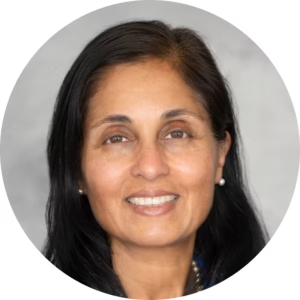

Nita Nautiyal is a business strategist specializing in project development and investment decision-making. She has more than 30 years of experience spanning public policy, consulting, and the global energy sector. After beginning her career in the policy and consulting worlds, she has spent the past 25 years working at a Fortune 25 energy company in roles across finance, strategy, business planning, and project management, helping organizations evaluate and lead complex projects and make disciplined capital investment decisions.
Nita holds undergraduate degrees in economics and political science and an MBA in finance. Her work and writing increasingly focus on leadership development, team dynamics, and how individuals intentionally build strong networks of support—what she calls “building your bench.”
Enjoyed todays episode? Register now to be the first to receive new episode alerts:
This content has been developed independently by Touch Medical Media. Unapproved products or unapproved uses of approved products may be discussed; these situations may reflect the approval status in one or more jurisdictions. No endorsement of unapproved products or unapproved uses is either made or implied by mention of these products or uses by Touch Medical Media. Views expressed are the speaker’s own and do not necessarily reflect the views of Touch Medical Media.