Open Nav
Open Nav

Check your Inbox
We've sent your certificate

Thank you
for your Feedback!
Activity Overview
CARE Legacy
Faculty and Disclosures
References & Publications
Activity Overview
CARE Legacy
Faculty and Disclosures
References & Publications

Prof. Martin Hoenigl
Medical University of Graz
Biography
Prof. Martin Hoenigl is an Associate Professor for Translational Mycology at the Division of Infectious Diseases, Medical University of Graz, Austria. His research interests focus on clinical mycology, including fungal diagnostics, host-fungal pathogen interactions, and pharmacology of antifungal drugs. He has worked in mycology for over 15 years, and has published over 350 scientific papers. He is the past president of the European Confederation of Medical Mycology (ECMM), and serves an editor for several leading mycology journals.
Disclosures
Received research funding from Basilea, Gilead, Elion, F2G, GSK, IMMY, Pulmocide, Melinta, Mundipharma, Pharmaholdings, Shionogi and Scynexis.
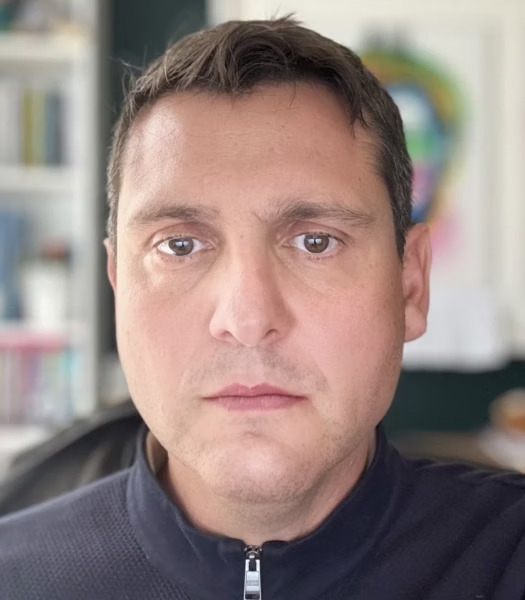
Prof. Ignacio Martin-Loeches
Dr Souha Kanj

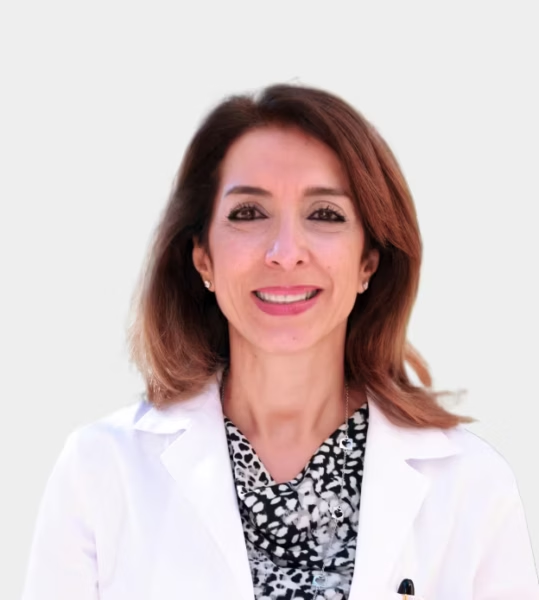
Dr Souha Kanj
American University of Beirut Medical Center
Biography
Dr Souha Kanj is a Professor of Medicine at the American University of Beirut Medical Center (AUBMC), and Chair of the Infection Control Program, co-Chair of the Antimicrobial Stewardship Program, and Consulting Professor at Duke University Medical Center. Her research focuses on nosocomial infections, antimicrobial resistance and stewardship, nosocomial infections, infection control, ID during wars, and fungal infections. She has co-authored over 325 peer-reviewed articles, book chapters, and UpToDate® cards. She serves as an advisory member for WHO programs in infection control, antimicrobial resistance, priority pathogens, diagnostic stewardship, COVID-19, and fungal infections.
Disclosures
Honoraria for speaker and advisory board member for Menarini, MSD, Pfizer, Hikma, Gilead. Author of UpTodate cards. Participated in ECMM guidelines.
Prof. Martin Hoenigl

Prof. Johan Maertens

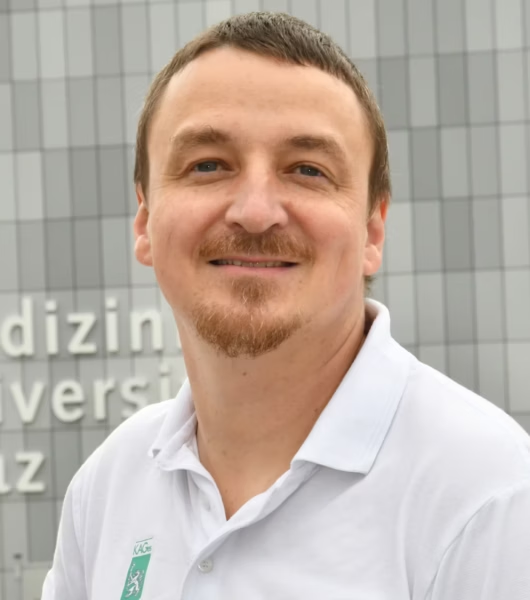
Prof. Johan Maertens
University Hospitals Leuven
Biography
Prof. Johan Maertens is a hematologist and Associate Professor at University Hospitals Leuven, Belgium. His work focuses on invasive fungal diseases, particularly in immunocompromised patients. He has authored more than 450 scientific publications, is a founding member and current chair of the European Conference on Infections in Leukaemia (ECIL), a past chair of the EORTC Infectious Diseases Group, and a Fellow of the European Confederation of Medical Mycology.
Disclosures
Grants or contracts from F2G, Gilead, MSD, Mundipharma, Pfizer. Consulting fees from Abbvie, Servier, Basilea, Takeda, Daiichi Sankyo, Cidara, Asahi Kasei Pharma Corporation, Gilead, Elion Therapeutics, Novo Nordisk, MedPace, Menarini, Mundipharma, Pfizer, Scynexis, Shionogi, Biosergen and Octapharma. Speaker and lecture honoraria from Takeda, Abbvie, Gilead, Medscape/WebMD, MSD, Mundipharma, Pfizer, Shionogi. Payment for expert testimony from Cidara, Mundipharma and F2G.
Dr Souha Kanj
Prof. George Dimopoulos
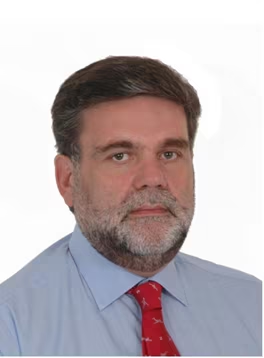
Prof. George Dimopoulos
National and Kapodistrian University of Athens
Biography
Prof. George Dimopoulos is a Professor of Pulmonary and Critical Care Medicine at the National and Kapodistrian University of Athens, Head of the 3rd University Department of Critical Care at EVGENIDIO Hospital and Consultant in Critical Care in Therapeutic Clinic at ALEXANDRA Hospital, all in Greece. He has authored more than 300 scientific papers and reviews and contributed to more than 70 book chapters. He is a former chair of the Respiratory Infections Assembly of the European Respiratory Society (ERS) and Infection Section of the European Society of Intensive Care Medicine (ESICM), a past Education Officer of the European Society of Clinical Microbiology and Infectious Diseases (ESCMID) Study Group for Critically Ill Patients, and a Fellow of the European Confederation of Medical Mycology (ECMM).
Disclosures
Advisory boards: Menarini, Gilead, MSD and VERMA Drugs.
Prof. Johan Maertens
Prof. Ignacio Martin-Loeches

Prof. Ignacio Martin-Loeches
Trinity College Dublin and St James’s Hospital
Biography
Prof. Ignacio Martin-Loeches is a Professor of Intensive Care Medicine at Trinity College Dublin and Consultant at St James’s Hospital, Ireland. He specializes in severe infection, sepsis, and ICU acquired respiratory disease and has authored more than 600 peer reviewed publications, including on critical care guidelines and translational infection science. He serves as Chair of the Critical Care Group at the European Respiratory Society and Chair of Research at the European Society of Intensive Care Medicine, currently leads the ERS European Network for ICU-related Respiratory Infections, and is a former Steering Committee member of the Surviving Sepsis Campaign.
Disclosures
Received funding from Gilead, MSD, Mundipharma, Pfizer and Thermofisher.
Prof. George Dimopoulos
Prof. Martin Hoenigl
touchEXPERT INSIGHTS
Access to this content is not permitted for healthcare professionals in UK.
Close Popup
touchEXPERT INSIGHTS
This content is intended for healthcare professionals globally (excluding UK).
Please confirm that you are a healthcare professional outside UK.

This activity is funded by Gilead Sciences, Inc. and is intended for healthcare professionals only.
The content of this activity is non-promotional and aims to provide an update on the most relevant recent publications on invasive fungal infections.
Gilead Sciences, Inc. provided financial support and content, and has had input into the detailed project scope. This activity is provided by Touch Medical Communications (TMC) for touchINFECTIOUS DISEASES.
Close Popup
Could not verify Country/IP Address.
We were unable to verify your IP address, please try again later. If you are using a method to hide your IP address, such as a VPN or proxy, please disable this and try again.
This is a non-promotional activity sponsored by Gilead Sciences, Inc.
This activity is funded by Gilead Sciences, Inc. and is intended for healthcare professionals only.
The content of this activity is non-promotional and aims to provide an update on the most relevant recent publications on invasive fungal infections.
Gilead Sciences, Inc. provided financial support and content, and has had input into the detailed project scope. This activity is provided by Touch Medical Communications (TMC) for touchINFECTIOUS DISEASES.

Gilead medicinal products may be mentioned in the scientific discussion. Please refer to the locally approved prescribing information for AmBisome Liposomal (Amphotericin B), as product information may differ between countries.
Adverse events should be reported to Gilead at Safety_FC@gilead.com and/or through your national reporting system.
TMC accepts no responsibility for errors or omissions.
The views and opinions expressed are those of the faculty and do not necessarily reflect those of any sponsor.
GFM-UNB-2063
Date of preparation: January 2026
Log into your Touch Account
Keep track of your clinical interests and newsletter subscriptions.
Sign up with an Email
Or use a .
Register now for FREE access
Already registered? Login below.